
Feldenkrais Garden Series: Easy Reaching & Squatting Tips
A 5 lesson Feldenkrais® Awareness Through Movement Series with Sarah Baumert
This is Part 2 of a three-part series exploring how Feldenkrais Awareness Through Movement® applies to daily life. Part 1 covers reaching overhead, reaching down to the floor, and spinal rotation movements, and Part 3 focuses on navigating stairs with ease.
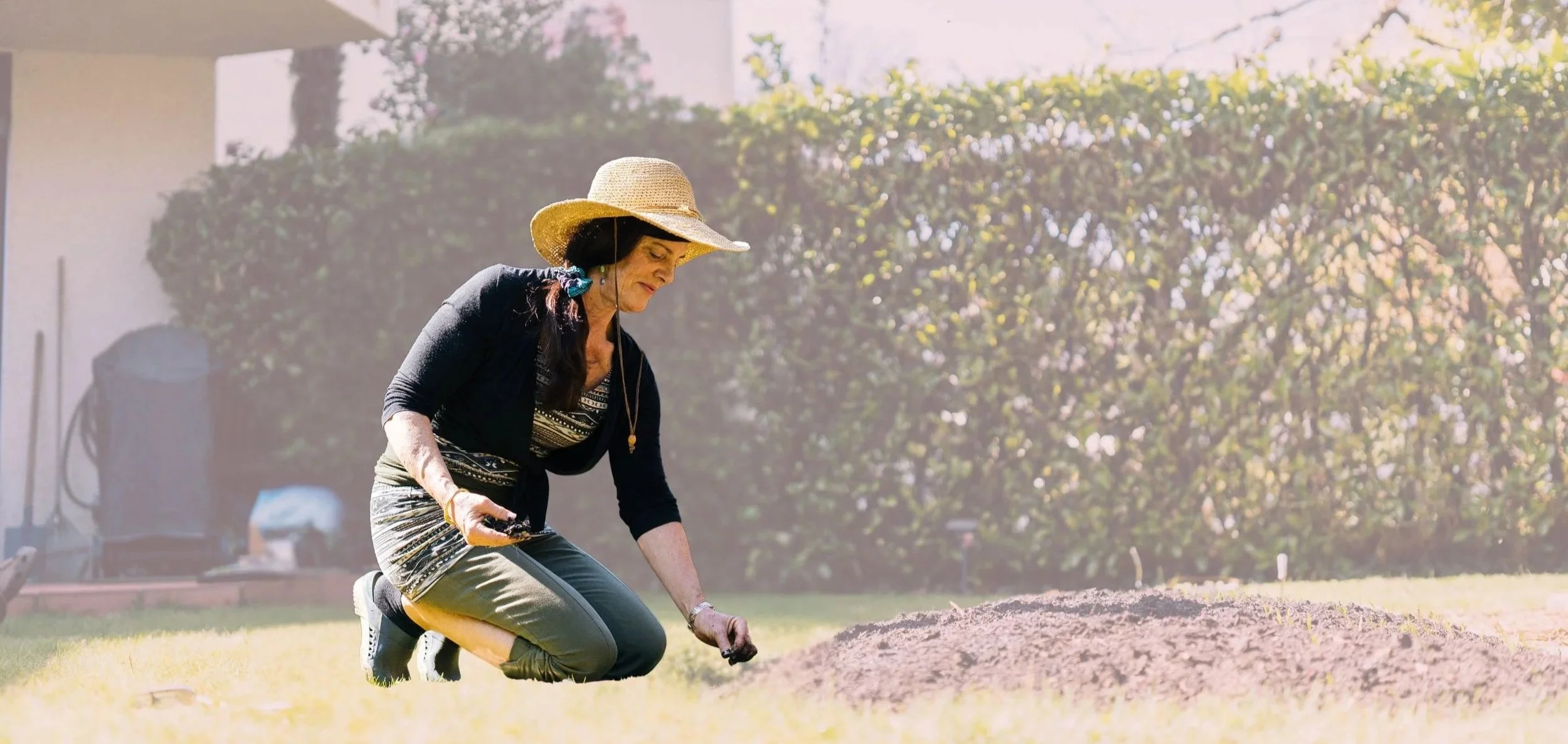
In Part 2, our focus is heading down to earth for those requests to make gardening easier: squatting, kneeling, and low-to-the-ground tasks. Now, you might look at that focus and think, "I don’t do much gardening, so will this series apply to me?" When we work with squatting or getting low to the ground, we aren't just practicing a single posture; we are exploring the delicate, interconnected coordination and relationships of the ankles, knees, hips, and lower back. Reorganizing how these major joints communicate with one another has a massive ripple effect, unlocking a multitude of useful functions for your entire life.
Even if a full squat is not accessible or comfortable for you right now, these lessons are designed to meet you exactly where you are, offering deep benefits for your overall mobility. Consider how the underlying habits we refine in this series ripple out into your everyday world:
Unlocking the Ankles and Knees: We often think of squatting as a hip or back issue, but rigid ankles and knees force the rest of the body to overcompensate. By finding mobility and better weight distribution in these joints, you will find smoother transitions whenever you bend, pivot, or walk on uneven ground.
Getting Down and Back Up: The mechanics of a low squat translate directly into getting in and out of a low car with ease, or getting up and down from the living room floor to play with grandkids.
Finding Comfort While Kneeling or Bending: Restoring the proper relationship between your knees and hips opens up the tight lower back tension that can make long periods of sitting or standing uncomfortable.
In other words: How you do anything is how you do everything. By using the garden as our playground in Part 2, we are actually learning how to move through the world with more grace, less effort, and a deeper sense of comfort—no green thumb required!
“I know that one of the reasons I can play with my grandchildren, teach them to ride a bike/scooter, carry the youngest, and keep up with them in general is because of yoga/Feldenkrais lessons and practice. I am very grateful.”
$125 for the 5 lesson course
For scholarship options, please inquire directly with Sarah at sarah@body-matter.com
Pay-as-able and payment plan options available at check out.
Is This for You?
This series is designed for anyone who wishes to bridge the gap between the mat and the world. Whether you are seeking to refine a high-level skill or simply want to navigate your daily environment with greater confidence and less strain, these lessons will provide some practical tools to meet your goals. Come prepared to investigate your habits and discover the joy of more efficient, dependable movement.
What You’ll Discover In This Online Series:
Movement: This series will include five lessons. Two variations of each lesson are taught, once on Wednesday and once on Sunday.
Lessons included in this series:
1. Heels, Angles, and Timing for Squatting
2. Clarifying the Hip Joints for Squat
3. Toes in Transition
4. Spring Loaded: From Squat to Quadraped
5. Reaching and PullingWays to keep practicing:
• Option to download recordings and stream recordings indefinitely
Supportive Community and Connection:
• Recorded Q & A to listen to questions, connect with the other students, and discuss the method and tools we are learning about.
• Optional 10 minute consultation with Sarah
• Online forum to connect and ask questions if you are doing the recordings
• Email supportOnce you have purchased the course, you will have immediate access to the class recordings.
How to use the Marvelous software for livestream and recorded classes.
FREQUENTLY ASKED QUESTIONS:
-
Starting in the 1930’s, Dr. Moshe Feldenkrais began to develop a somatic form of neuromuscular re-education. Feldenkrais developed two practical approaches for exploring early developmental movements, as well as more advanced complex actions.
1) Functional Integration - manually directed, hands on, private lessons. Learn more about the 1:1 Feldenkrais approach here.
2) Awareness Through Movement - verbally guided mindful movement classes done in a group setting.
Both approaches are described as “lessons”, as they involve beneficial learning processes for the brain and body. In guided Awareness Through Movement classes you study your potential to act, and how you refine your self organization to make any movement. Feldenkrais is not stretching or straining, it is learning. The method uses gentle mindful movement and directed attention to help people learn new and more effective ways to move and be in the world.
-
The optimal frequency for practicing Feldenkrais depends on your individual goals. While daily practice is possible and can be very effective, beginners may find it helpful to start with 2–3 sessions per week. Practicing regularly, even just 10–20 minutes a day, can build consistency and support a deeper connection between the body and brain. Since the method is gentle and non-invasive, it can be done frequently without risk of strain. The effectiveness of the practice comes more so down to the quality of your attention in any amount of time given to the method.
-
Yes! It’s not uncommon for students to feel taller and to stand more upright (with less effort) after a Feldenkrais session. Most all humans “hold” the body with a specific tone in the muscles. Over time this muscular tone habituates and becomes our “posture”, for better or worse. Using guided awareness and small movements in Feldenkrais lessons, the body can shed its unnecessary muscular tone, so that the skeleton can then find its more optimal place to be.
“Although we each have a fantastic skeleton and musculature designed to give us flexible support and hold us upright against the pull of gravity, we frequently develop postural habits that challenge our skeletal structure's effectiveness and cause muscular tension inflammation, and a gradual deterioration of our joints.” - Feldenkrais Trainer David Zemach- Bersin
With awareness, specificity, and practice, Feldenkrais lessons can give you the ability to free the muscles of the neck, shoulders, spine, and pelvis. As one moves towards more freedom of the muscles, one also moves towards a more easy, elegant, and upright posture supported by the strength of the skeleton.
Our aim in Feldenkrais is not a perfect posture, but a place of less tension and conflict in the body where our posture is fluid, not rigid. Everyone’s posture, or how they “use” themselves, isn’t always optimal. With the help of the Feldenkrais method, your postural habits can improve to make everyday movements more enjoyable and easy.
-
Through subtle changes in how we relate to the present moment, memories, and future possibilities, the Feldenkrais Method can support anxiety management. Often, anxiety is tied to uncertainty about what lies ahead. Consequently, it can create a cycle of tension that affects both body and mind. Past experiences and imagined outcomes can trigger stress responses, often showing up physically as a clenched jaw, tight neck and shoulders, lower back pain, or shallow breathing.
Through Awareness Through Movement (ATM) lessons, Feldenkrais encourages small, gentle, and comfortable movements. These are designed not to force change but to invite ease and awareness. This approach works from the body upward—a sensory-based, bottom-up process—rather than relying solely on mental strategies to change our state. As we tune in to subtle physical sensations, we strengthen our ability to understand and respond to what’s happening internally—this is known as interoception. The more accurately we sense our internal state, the more effectively we can choose how to respond.
Feldenkrais also supports self-regulation. With consistent practice, the lessons help build a sense of internal stability, confidence, and adaptability. By fostering a state of calm and vigilant awareness, they prepare the nervous system to respond effectively to stress and challenges.
Dr. Feldenkrais described this shift as creating a tabula rasa, or blank slate—a return to a neutral, open state from which new patterns of movement and thought can emerge. Although life events are often beyond our control, Feldenkrais equips us to face them with increased resilience, adaptability, and insight.
-
Can the Feldenkrais Method support my nervous system? Can it help regulate it? And what does it mean to regulate the nervous system or to develop interoception?
The brain is an integral part of the body, no less than the lungs, muscles, or bones. Rather than viewing them separately, it's helpful to understand how deeply interconnected they are. These systems all work together and influence how we move, feel, and learn.
The nervous system is a network of structures designed primarily for communication throughout the body. At its core is the central nervous system (CNS), made up of the brain and spinal cord. From there, nerves branch out to every organ and region of the body; this is called the peripheral nervous system (PNS).
Included in the peripheral nervous system is the autonomic branch, responsible for managing the body’s involuntary functions, such as circulation, digestion, and respiration. The ANS has two main branches. The sympathetic nervous system, which prepares the body to act quickly in response to stress (commonly known as "fight or flight"). The parasympathetic nervous system helps the body slow down and recover ("rest and digest").
Essentially, the nervous system gathers information from inside and outside the body (like detecting light through the eyes or sensing acidity in the stomach), sends it to the brain for processing, and then generates a response. Afterward, it checks the effects of that response whether it helped or not. This feedback loop for regulated states reduces the basis of how we learn.Feldenkrais supports the regulation of the nervous system by offering gentle movement experiences that engage multiple senses and enhance awareness. By using gentle, mindful movement and attention, Feldenkrais engages the brain and body in a process of learning and self-awareness. These slow, exploratory movements stimulate sensory input and help the nervous system shift out of habitual patterns, especially those associated with tension, stress, or imbalance.
Regulating the nervous system means being able to shift between different states like stress and relaxation with more ease. It’s the ability to come back to a calm, grounded place after being activated by a challenge, emotion, or sensory input. However, a regulated nervous system doesn’t mean always being relaxed; it includes being adaptable, responsive, and resilient.
A regulated nervous system often involves a strong sense of interoception within the body. Developing interoception is the ability to sense what’s happening inside your body like your heartbeat, hunger, breath, tension, or fatigue. This system is part of your nervous system, and specifically, it involves communication between the brain and internal organs through pathways like the vagus nerve. The more attuned you are to these inner signals, the better you can understand and respond to your needs at the moment. For example, noticing that your breath is shallow or your jaw is tight can be a cue to pause and adjust.
Practices like the Feldenkrais Method are powerful tools for developing interoception. Through slow, mindful movement and focused attention, Feldenkrais invites you to tune in to subtle sensations that often go unnoticed in the business of day to day life. This method gently guides you to observe how you move: how your breath flows, where you hold tension, which movements feel smooth or restricted. By bringing awareness to these details, you may begin to uncover habitual patterns that may be creating unnecessary effort or strain. This inner awareness is a foundation for nervous system regulation and overall well-being.
Feldenkrais lessons often begin by helping the nervous system downshift, where learning and integration become possible. It’s about becoming more aware of what’s actually happening inside, noticing your muscle tone, your posture, your breathing patterns, and your habitual reactions. Feldenkrais invites active participation. Rather than relaxing from the outside in, you're guided through movement and attention to explore how you function from the inside out. Discovering new possibilities of how you rest, sit, breathe, walk, see….You might ask yourself:
Am I holding my breath to do this?
Does this movement feel better or worse when I shift slightly?
Is there more effort here than I need?
These questions help you integrate what you've just experienced, rather than returning to unconscious patterns. Each of us will process it in our own individual way with a range of possibilities to learn more about who we are and where our nervous system is currently at. We ask the systems of the body permission to listen and learn rather than dictating how we want it to feel from our “doingness”. Maybe when you ask and look, a sensation of fatigue may settle in and you then realize how exhausted you are. From that space of balance and recognition of your true internal state, the nervous system can then in time gain access to faster, sharper, and more spontaneous responses. Ultimately helping every system and organ in the body. You become able to move, speak, react, or shift directions at the appropriate time and place in your internal and external environment.Health, as Moshe Feldenkrais saw it, isn’t a fixed state. It’s a dynamic condition, the ability to recover from challenges, to regain position after being tilted off course. Mark Reese, worded it in this way:
“Whereas health is conventionally thought of as a static state to be maintained, Moshe defined health as a dynamic condition, the ability to recover from shocks... Health is the capability of regaining balance and standing poised again on one’s feet.”
-
Both practices emphasize listening to your body, respecting its limits, and unlocking its potential. These two methods use movement as a means of learning through the nervous system. In Patanjali’s Yoga Sutras, the phrase Chitta Vritti Nirodha often translated as “stilling the waves of the mind” is described as the ultimate goal of yoga. Similarly, Moshe Feldenkrais frequently remarked that his aim was not simply to create flexible bodies, but rather flexible minds.
While the two methods share many similarities, they differ in their approaches, each offering a unique pathway to self-discovery. A seasoned yogi may find that Feldenkrais deepens their internal awareness, while a Feldenkrais practitioner might uncover greater strength and vitality through the practice of yoga.
While most yoga practices place significant emphasis on alignment and the external shape of a pose, the Feldenkrais Method takes a fundamentally different approach. Rather than aiming to hold positions or push the body toward the edge of flexibility, Feldenkrais focuses on the internal experience of movement specifically, the coordination, quality, and efficiency of how one moves.
In a typical Feldenkrais lesson, there are no prescribed shapes or postures to achieve. Instead, practitioners engage in gentle, mindful movement sequences based on developmental patterns, the kinds of movements we naturally explored as infants when learning to roll, reach, crawl, or walk. These movements are performed slowly, within a comfortable range, and always without strain.
This deliberate gentleness is essential to Feldenkrais. By staying within a pain-free, non-threatening range of motion, the nervous system remains in a state where it can safely observe, adapt, and reorganize. This is key to the method’s focus on neuroplasticity: learning new, more efficient ways of moving through direct sensory experience.
While yoga often encourages the body to fit into specific postures, the Feldenkrais more specifically invites you to investigate how movement occurs and how it might be done with less effort. Instead of striving toward an external goal or ideal form, Feldenkrais emphasizes the process of learning and self-discovery. This shift from outcome to experience fosters deeper internal awareness and sustainable improvement in how we move and feel.

About Sarah: Sarah Baumert is known for her thorough and diverse instruction and her dedication to holding space for individual personal discovery. She facilitates whole body alignment in her students as a way for them to access balance, strength, mobility and physical clarity. Through sensory rich movement experiments, she guides students in cultivating mindfulness and deepening their learning process. She works with a variety of populations including athletes, seniors, artists, dancers, musicians, and those experiencing injury or surgery recovery. Sarah is a certified Yoga Therapist, an Authorized Feldenkrais Awareness Through Movement® Teacher and Feldenkrais Functional Integration® Practitioner. Her objective is to acquire the most effective skills for helping her students live with less pain and more pleasure in their bodies.
What people are saying about Sarah's teaching:
““At the end, when we went to stand up, my shoulders felt wider and like I was standing broader. I felt more stable and steady as I stood there.”- Cara
“It was amazing to me, to notice the marked difference after one lesson.”- Kathy Z.
“I walked today, and could really connect with the shoulder and torso movements that support/energize walking from our Wednesday night lesson! This series is promoting new body awarenesses for me around easeful walking and everyday movement.”- Tracie
”I really don’t know what I would do without our yoga and Feldenkrais community that you have nurtured. Without this regular practice and participation, it is easy for me to be pulled in too many directions, becoming anxious and worried, distraught and distracted. Experiencing my body through your lessons is like “touching base” with the safe boundary that contains who I am. I feel more centered and certain of both my limitations and my strengths. I am learning to do less and not take on too much; to say “no” when I do not have the capacity for an unexpected request; to say “yes” everyday to experiences and activities that evoke joy in my body (like walking outside) and peace of mind.” - Helen
I am so grateful that you continue to provide these life giving, body strengthening and soul nurturing classes. They are like an inner meditation for every cell in my body! - Rosie
After I switched to the ‘regular’ yoga class, I realized I missed how I felt during and after Feldenkrais. I experience an ease of being, a soft wholesomeness, in Feldenkrais. I meditate most mornings, and I sometimes find that same stillness after Feldenkrais. Also, ease of movement: I am always struck at how gracefully I can move a limb compared to how the limb starts out. -Elizabeth
What I love so much about your classes: when the unexpected happens, like a jigsaw puzzle falling into place. Keep surprising me! - Jane
I find your classes to be exceptionally supportive and illuminating, and I’ve so benefitted from the learning and the unlearning I’ve experienced. Drop by drop, this practice and what I’ve received from your teaching have radically changed how I am in my body and in my life. These online Feldenkrais courses have become some of my favorite practices ever, and I’m excited every time you propose a new series. - Betsy”